

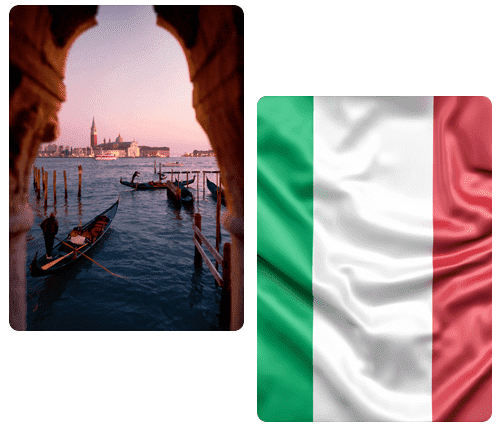


ITALY
Study In Italy
Italy is a really important country in the world. Its economy is the 3rd biggest in Europe and the 8th biggest in the whole world. It makes and sells a lot of things other countries buy, like fancy clothes (brands such as Gucci, Prada, Armani, and more) and famous cars (Ferrari, Lamborghini, Fiat, etc.). Italy also has some of the best hospitals and doctors, according to the World Health Organization.
The country is split into 20 regions, with beautiful and famous cities like Rome, Venice, Florence, and Milan that many people visit. About 59 million people live there, and in 2024 Italy’s economy is expected to make over $3 trillion. It’s also home to the world’s oldest university!
For more information: +91 90586 71436
Why study in Italy?
- Italy has really good, world-famous universities.
- You can get a full scholarship that pays for your tuition, hostel, and even gives you money to live on.
- Master’s students can get around ₹12–15 lakhs, and Bachelor’s students around ₹18 lakhs as a stipend.
- After finishing, you get a one-year work visa that lets you work in 27 European countries.
- You don’t need exams like GRE, GMAT, or SAT to apply.
- Students can work part-time while studying and earn about ₹80k–1 lakh per month.
- Italy has one of the best healthcare systems, and it’s free for students.
- It’s a country that makes it easier to stay long-term (PR friendly).
- You can also do internships or get placed in other European countries like Germany, France, or the Netherlands through ERASMUS.
👉 Basically: Study in Italy = free education + free living + job opportunities + explore Europe.
Get Free Expert Consultation..
Careers & Jobs in Italy
Italy has a strong economy with many industries like fashion, cars, design, tourism, tech, and more. There are over 4.5 million companies, so lots of job opportunities are open for students after graduation.
If you study engineering, fashion, business, or technology, you’ll find many chances to work, since Italy is growing fast in digital innovation. In the future, jobs will also grow in renewable energy, AI, and sustainability.
Knowing Italian and understanding the culture makes it even easier to join big international companies and improve your career options.
👉 In short: Italy = many companies + great jobs for graduates + big future in tech and green industries.
Get In Touch With Us: +91 90856 71436
Popular Courses
- International Business Management (IBM)
- International Business (IB)
- Economics & Finance
- All Engineering & Technology (Computer Science, Artificial intelligence, Data Science & Robotics, Automobile Engineering, Mechanical Engineering, Civil Engineering, Electrical Engineering, Chemical Engineering, Aerospace Engineering, etc.,)
- International Tourism & Destination Management, Hotel Management
- Art & Architecture
- Agri & Food Science (Culinary)
- Bio, Biotechnology & Bioinformatics
- Law
- Pharmacy
- Nuclear Science & Nuclear Energy
- Fashion Studies
- History, Geonomics Many More.
Get Free Consultation: +91 90856 71436
POPULAR UNIVERSITIES

Politecnico di Milano
University of Naples – Federico II
Sapienza University of Rome
University of Turin
Alma Mater Studiorum – Università di Bologna
University of Florence
Università di Padova

University of Pisa
Politecnico di Torino
Lorem ipsum dolor sit amet, consectetur adipiscing elit. Ut elit tellus, luctus nec ullamcorper mattis, pulvinar dapibus leo.
University of Rome “Tor Vergata”
University of Milan

University of Parma
F.A.Q.
Everything so dispatched as it increasing pianoforte.
- World-Class Universities
- High-Quality Education and Research
- 100 % Scholarships and Financial Support
- Post-Study Work Opportunities
- Recognition and Mobility within Europe
Yes, However, many Italian public universities offer scholarships and grants that can cover tuition fees and living expenses, making education almost free for eligible students.
Yes, Italian government scholarships, these scholarships can cover tuition fees, accommodation, and living expenses.
Many universities in Italy offer programs taught in English, but you may need to demonstrate proficiency in English through tests like IELTS.
Yes, international students in Italy can work part-time for up to 20 hours per week during the academic year and full-time during vacations.
The cost of living depends on the city. On average, students need about €400 to €600 per month to cover living expenses, including rent, food, transport, and leisure.
Yes, international students from non-EU countries will need a student visa to study in Italy. After receiving an offer letter from an Italian university, you must apply for a long-term (D) student visa through the Italian consulate or embassy in your home country.
Some of the most affordable public universities in Italy include the University of Bologna, Sapienza University of Rome, and Politecnico di Milano.